Overview
Problem
High-end roasting requires more than telemetry. The system must follow a lagging physical process, coordinate hardware, support immediate manual takeover, and preserve each session for review.
2025 · alpha qa · Lab control system
Autonomous Roasting Operating System
An autonomous control system for sensors, heat, airflow, safety limits, manual takeover, and roast profile tracking.
Overview
High-end roasting requires more than telemetry. The system must follow a lagging physical process, coordinate hardware, support immediate manual takeover, and preserve each session for review.
Implementation
Operator view
A grounded representative view connects roast phase, material color, telemetry, safety state, and the operator's control context without presenting a cinematic simulation.
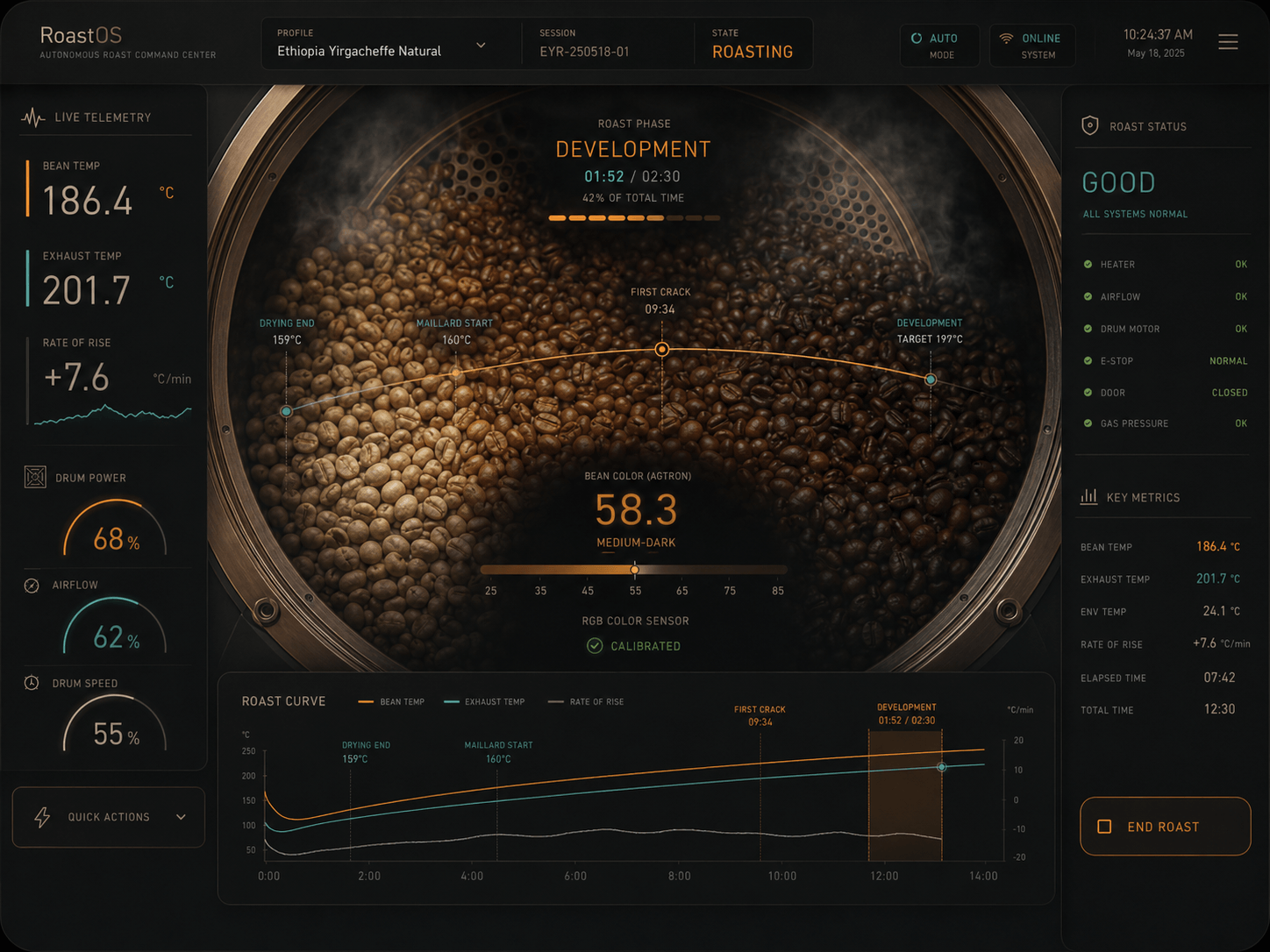
Roast-state calibration
Bean state is read as a progression in material color and process phase, not as theatrical warm lighting.
RoastOS
Select a screen to review full size
How it works
Key details
Recovered source material was used only to describe capabilities. Public reconstructions exclude credentials, network values, private paths, and identifiers. Safety behavior remains under Alpha / QA-before-production review.
Capabilities
Tracks target profiles through sensor state, predictive control, and coordinated heater, blower, agitator, and chaff-fan commands.
Connects live curves, first-crack marking, RGB color tracking, digital-twin state, and profile-objective matching.
Links profiles, sessions, bean identity, inventory, expected yield, final results, notes, and refinement suggestions.
Outcome
A four-view lab system showing how physical control, operator experience, bean identity, and profile engineering can make a complex roast process understandable and controllable.
Why it matters
RoastOS shows how sensor-driven automation can combine hardware control, safety limits, telemetry, manual takeover, and a clear operator screen.
Related field notes
Related projects worth exploring